Estimating OPL and power curves from limited data
Accurately estimating an athlete’s optimum power load (OPL) is essential for prescribing individualized power training. The OPL is defined as the load that maximizes power output in a given exercise and is typically derived from the load–power relationship using bar-velocity and bar-force measurements. Bar-power at the OPL has been strongly associated with sport-specific performance across multiple disciplines, including sprinting, jumping, combat sports, and various team sports, as noted by Loturco et al. (2022).
In practice, athletes perform repetitions as explosively as possible across several incremental loads, and power is computed as the product of bar force and bar velocity. The load producing the highest power output is designated as the OPL. This assessment can be carried out with a variety of devices (including linear position transducers, accelerometers, and force plates), which provide valid and reliable measures for constructing the load–power curve.
Note: The code I wrote for all simulations, figures, and analyses in this article is available in the following Jupyter notebook:
Motivation
During real-world athlete monitoring, two factors often limit how thoroughly athletes’ OPL and power curve can be assessed.
First, testing time is limited, and fatigue management for athletes is a concern, making it impractical to assess velocity for a wide range of loads often.
Second, it is impractical to collect data on lighter loads for specific movements involving bodyweight, such as pull-ups. This limitation often means data do not include load ranges that maximize power output, especially when testing less powerful athletes.
In both situations, the collected data may not capture the true OPL, forcing coaches to estimate it through statistical extrapolation. Unfortunately, the scientific literature offers limited guidance on which modeling approaches yield the most reliable OPL estimates and power extrapolations.
This study addresses this gap by using controlled simulations to compare two common estimation strategies: linear force–velocity modeling and quadratic polynomial fitting of the power–load relationship.
Why a simulation-based method?
A simulation framework enables precise evaluation of OPL estimation methods because the true underlying force–velocity profile is known. This makes it possible to measure estimation error directly—something that cannot be done using real athlete data. Simulation enables controlled manipulation of fatigue, noise, and test-load constraints, supporting fair comparisons between models under realistic field conditions.
Simulation assumptions
-
Velocity decreases linearly as load increases.
This reflects the well-established approximate linearity of the force-velocity relationship.
-
Power is modeled as load x velocity x gravity.
This represents barbell power as used in velocity-based training research.
-
Random noise is sampled from a negative half-normal distribution.
This models the physiological fact that an athlete cannot exceed their “true” ideal velocity, but can perform worse due to inconsistency in movement execution, coordination, or readiness fluctuations.
-
Fatigue is imposed multiplicatively, reducing velocity across successive test trials.
This represents the fatigue accumulation during testing.
Simplifications:
The magnitude of fatigue is assumed to follow a regular, linear progression based on the order in which the loads are performed.
Fatigue is modeled independently of the relative load (%1RM) or the number of repetitions in reserve (RIR). Its size depends solely on test order rather than load intensity.
-
The simulation assumes that athletes begin testing in a stable performance state. It does not model the transition from incomplete warm-up to full readiness.
For simplification, the simulation doesn’t model post-activation potentiation (PAP), the short-term potentiation effect that can temporarily increase velocity after prior muscle activation.
-
Loads are tested in a fixed order (lighter to heavier), so fatigue interacts with load similarly to real test designs.
Only 5 loads are sampled per test to mimic time-limited athlete monitoring protocols.


Estimating the power curve
How each method estimates the power curve:
Linear method
A linear regression is fit to the relationship between velocity and load: v(L) = a + bL
The predicted velocities are then used to compute power at any load: P(L) = L · v(L) · g
Polynomial method
A quadratic regression is fit directly to the power–load data: P(L) = αL² + βL + γ
The resulting polynomial is used to compute power at any load by evaluating this equation.
Analysis
Across all simulation conditions, the linear model consistently outperformed the quadratic polynomial fit in both estimating the optimum power load (OPL) and extrapolating the power curve beyond the sampled loads. While both methods recover the general shape of the power–load relationship within the load interval of the collected data, their behavior diverges sharply as we extrapolate beyond this range.
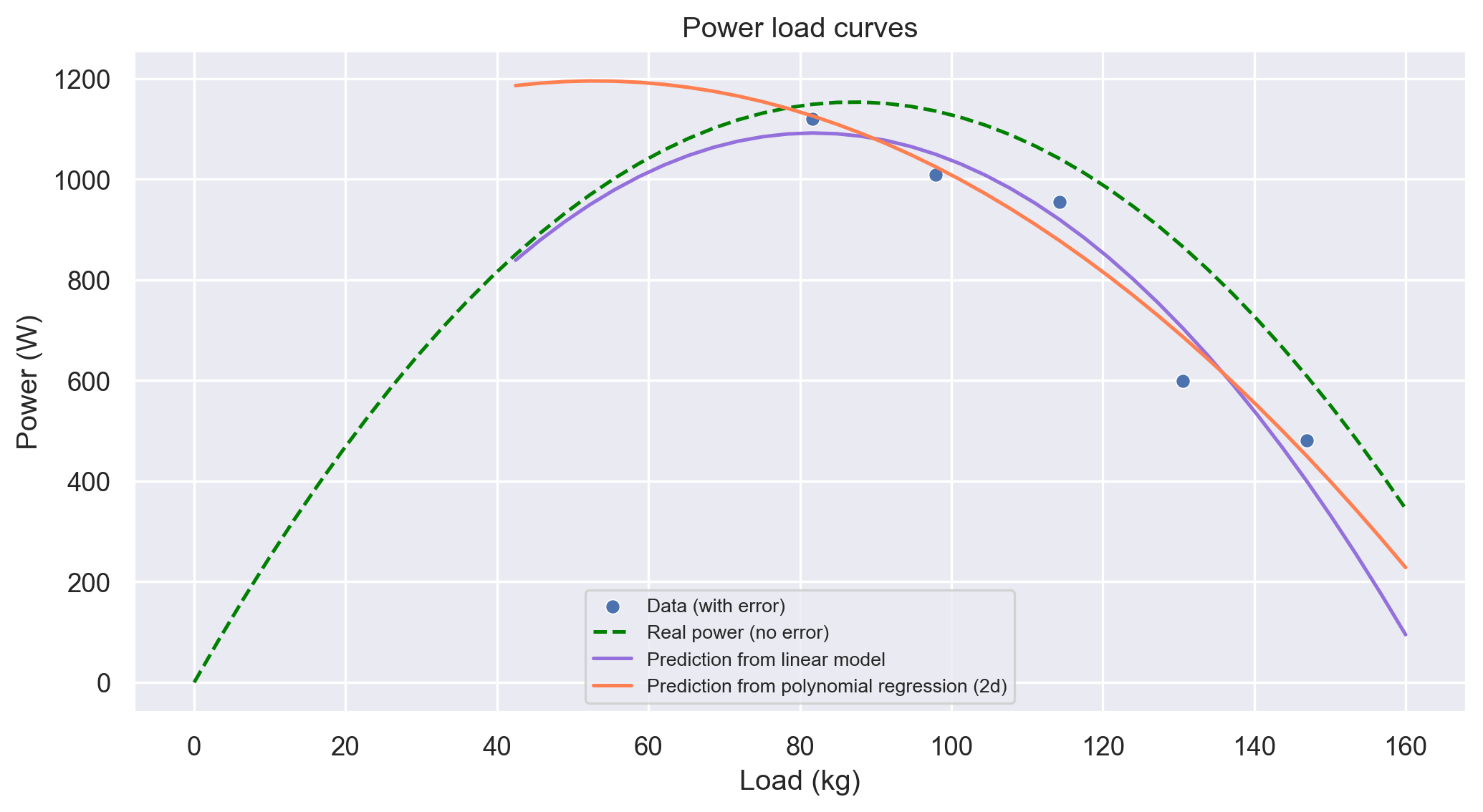
The figure below shows 1000 simulated power–load curves estimated independently by each method, overlaid on the true error-free curve. This visualization highlights the fundamental difference in how the two models behave under noisy test data.
Linear model
The linear F–V approach produces estimated power curves that consistently mirror the true mechanical shape of the underlying power–load relationship. Although individual curves vary due to random performance fluctuations and fatigue, the estimates remain tightly clustered and maintain a smooth, physiologically realistic trajectory. This stability arises because the linear model imposes a monotonic, biomechanically grounded velocity–load relationship, limiting unrealistic deviations.
Polynomial model
In contrast, the quadratic polynomial approach is highly sensitive to noise in the limited sampled test loads. Because the polynomial is unconstrained and attempts to bend to the exact location of noisy data points, small changes in the measured velocities cause significant fluctuations in the predicted power curve—especially at the load extremes where empirical data are sparse or absent. This produces wide variability in estimated power and erratic behavior when extrapolating (especially to lighter loads). Some simulated polynomial fits even curve upward at low loads, reach negative values, or peak far from the actual OPL.
Higher polynomial degrees would not improve the situation because the true power–load curve is not shaped by an arbitrary polynomial process. Higher-order polynomials introduce additional inflection points that lack a biomechanical basis and tend to amplify noise rather than capture the underlying force–velocity mechanics.
Note: In the simulation, at higher loads, both models tend to underestimate power due to the interaction between fatigue and test order and the negative-only random-error structure.
Quantitative evaluation metrics
OPL absolute error
To evaluate OPL accuracy, we computed the absolute difference between the true OPL (from the error-free curve) and the estimated OPL from each model prediction on all simulations. This reflects the practical question of how far each method deviates from the real OPL.
Across all simulations, the linear force–velocity method consistently produced smaller, more stable OPL errors than the quadratic polynomial fit. Median absolute OPL error was substantially lower for the linear method, with narrower variability. In contrast, the polynomial model showed a wide spread of errors. A paired Wilcoxon signed-rank test confirmed that the linear method yielded significantly more accurate OPL estimates (p = 1.7 × 10⁻¹¹¹).
Overall, the results show that the linear force–velocity approach provides more accurate and reliable OPL estimates than the quadratic polynomial model, especially when only a small range of test loads is available.

Model fitting performance: R² and RMSE analysis
To assess how well each method reproduced the true power–load curve, we examined the distributions of R² and RMSE across 1000 simulations.
The linear model showed consistently higher and more tightly clustered R² values, indicating that it reliably captured the underlying curve despite noise in the measured data. In contrast, the polynomial model displayed a wide range of R² values, including many negative ones: evidence that it often fit the true curve worse than simply predicting the mean.
Root Mean Squared Error (RMSE) results showed the same pattern. The linear method produced lower and more stable prediction errors, while the polynomial method exhibited a broad, right-skewed distribution with many large errors.
Overall, the fit metrics reinforce that the linear model not only estimates OPL more reliably, but also provides a more accurate and stable representation of the full power–load curve.

Sensitivity to measurement error
To evaluate how each model responds to increasing levels of error in the input data, we repeated the simulations across a range of error magnitudes. For each error level, we computed the mean, median, and standard deviation of RMSE and R² across 1,000 simulations.
Across all error levels, the linear model remained consistently more stable and accurate than the polynomial model. As noise increased, both models showed higher RMSE and lower R², but the polynomial model degraded much more rapidly.
Overall, these results show that the linear model is far more robust to measurement noise. This is a critical consideration for field testing, where small errors in velocity measurement are unavoidable.


Robustness across fatigue conditions
To check if the choice of fatigue parameters affected the outcome, I conducted additional simulations with various fatigue settings, such as:
fatigue affecting performance after the first set,
fatigue beginning only after the third set, and
a scenario with no systematic fatigue at all, where measured performance was influenced solely by random error.
Across all these scenarios, the pattern of results remained unchanged. The linear method consistently produced lower OPL estimation errors, higher R² values, lower RMSE values, and substantially less variability than the polynomial model.
Practical recommendations
In most scenarios, using the linear force–velocity model to estimate OPL and extrapolate the power curve will yield more accurate estimates. This is especially true when the true OPL may fall outside the tested load range or the test has few data points. This is common in movements where lighter loads are impractical to test (e.g., pull-ups).
When the tested loads span the region around the true OPL, both methods perform similarly for interpolation. However, in this scenario, the linear model also tends to provide a more accurate fit with the real power curve.
Avoid testing loads strictly in ascending order. Include heavier loads earlier or in the middle of the test session. When all loads are tested consecutively from light to heavy, fatigue accumulates systematically with load, making the velocity–load relationship appear artificially steeper than it truly is. By mixing the order, you reduce the correlation between load and fatigue. This separation yields more precise slope estimates for the linear F–V model, which will have a big impact on the accuracy of power estimation based on the model.
Ensure high-quality velocity measurements at the heaviest and lightest loads before fatigue settles in. In a linear regression of velocity on load, observations with extreme load values have higher statistical leverage. For this reason, accurate velocity data at the extremes of the load range improves the accuracy of the fitted line and the derived power–load curve.
Limitations
The simulation assumes a linear force–velocity relationship, negative-only random error, and a simplified fatigue pattern. While these reflect common trends in athlete performance, they do not capture all potential biomechanical or psychological factors affecting repetition velocity. These limitations do not undermine the comparative results but should be kept in mind when applying the findings to specialized settings.